
Returns & Refund Analytics
Track which products, variants, and channels have the highest return rates.
Returns & Refund Analytics
Returns don't just cost you the revenue — there's also restocking, and the margin on the original sale that's now gone. This page puts a real number on all of it.
Go to Performance → Returns to access it.
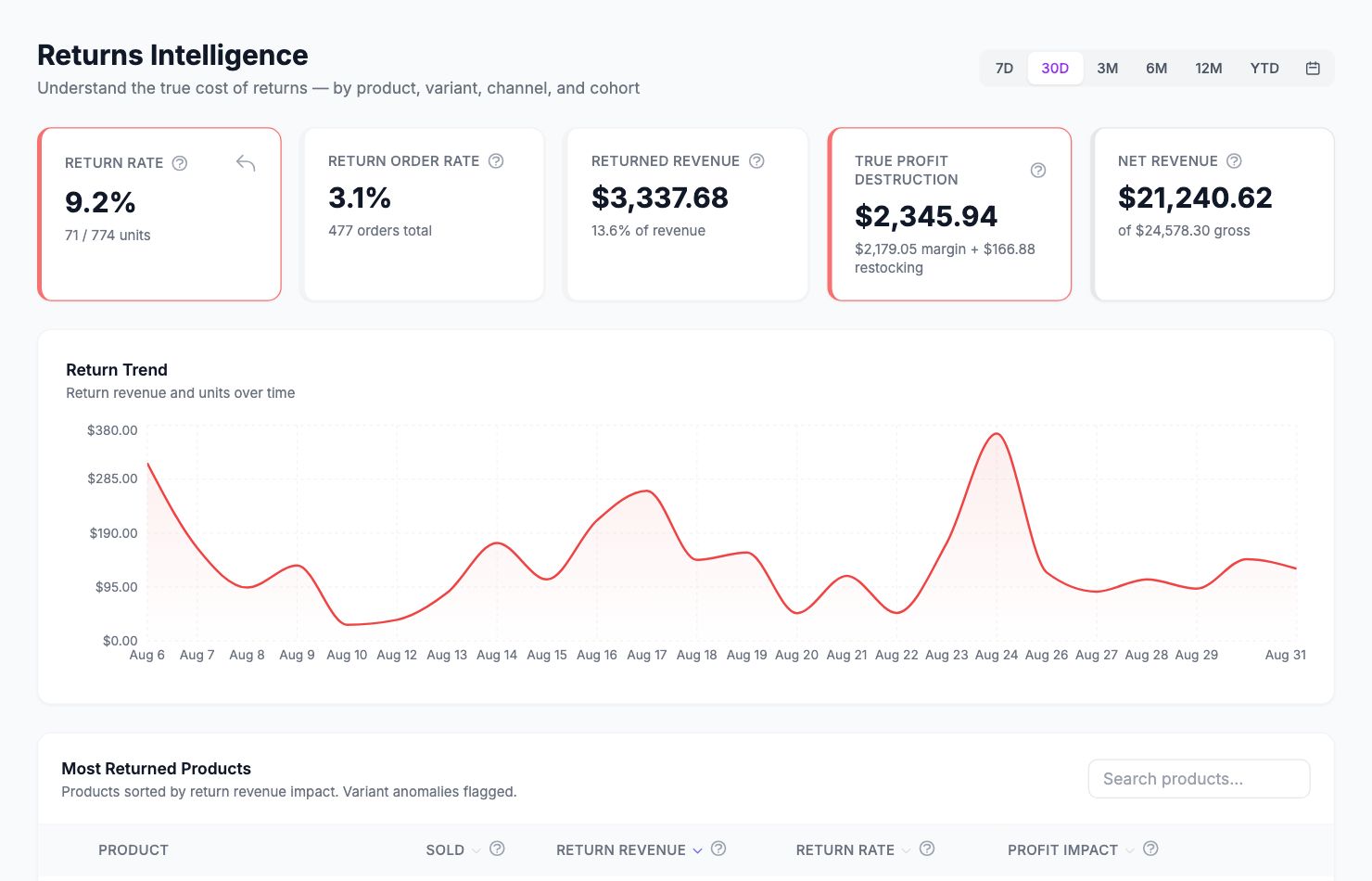
Overview metrics
Return rate (units) — the percentage of units sold that were returned. Under 3% is healthy for most product categories. 3-8% is worth watching. Above 8% usually means a product quality, sizing, or description problem.
Return rate (orders) — the percentage of orders that had at least one return. Often lower than the unit rate since customers sometimes return just one item from a multi-item order.
True profit destruction — the actual profit lost due to returns, not just the refunded revenue. This accounts for the cost of goods that came back, any restocking fees, and the margin you'd have kept if the order had stayed.
Lost margin — total margin lost across all returned orders.
Estimated restocking cost — a calculated estimate based on your average product cost.
Return rate thresholds
Shopimize color-codes return rates:
- ✓ Green: under 3%
- ▲ Amber: 3-8%
- ! Orange: 8-15%
- !! Red: above 15%
Product breakdown
The main table lists every product with returns, sorted by profit destruction by default. Click any product row to expand variants. This is where it gets useful: a product might have a 12% return rate, but if you look at variants, it might be 2% for most sizes and 35% for one specific size. That's a targeted problem — maybe that size runs small, or the product photos look different in that color.
Returns by channel
The channel breakdown shows return rates per sales channel. Higher rates on a specific channel can reflect different customer expectations, different demographics, or different product descriptions on that platform.
Return cohorts
The cohort table tracks when returns happen after purchase. Most returns happen within the first 30 days. Lots of 30-60 day returns usually signal buyer's remorse or quality degradation rather than a sizing or description issue.
What to do with high return rates
For a specific variant: check if the product description, photos, or sizing guide is accurate. A misleading listing is the most common cause.
For a specific channel: review how the product is presented there. Amazon listings sometimes get modified, which changes customer expectations.
For a whole category: consider whether product quality itself is the issue, or whether it's being sold to the wrong audience.
Related Articles
- Product Performance AnalyticsIdentify your most and least profitable products.
- Cost Tracking & ManagementAn overview of how Shopimize tracks every type of cost.
- Marketing ROI AnalysisMeasure real return on ad spend across all your channels.
- Profit & Loss ReportsGenerate and export P&L reports for your store.
- Customer Lifetime ValueUnderstand which customers are most profitable over time.
- Orders AnalyticsBrowse and filter orders with per-order profit and margin data.